
Table of Contents
- What Is Proprioception?
- How Proprioception and Aging Affect Movement and Balance
- Why This Matters for Athletes Over 50
- How to Train Proprioception at Any Age
- How Compression Enhances Aging Proprioception
- The Vision-Proprioception Trade-Off
- Fall Prevention: The Critical Importance
- Medication and Proprioception
- FAQs About Proprioception and Aging
- FAQs
- Precision & Grip Control
- Stability & Reaction Time
- Ground Feedback & Balance
- The Bottom Line
You’re walking across the pickleball court. Your foot catches on absolutely nothing. You stumble. Catch yourself. Look down to see what tripped you. There’s nothing there — a moment that reflects how proprioception and aging quietly affect movement.
Ten years ago, that stumble wouldn't have happened. Your ankle would have adjusted automatically. You wouldn't have even noticed the slight unevenness in the court surface.
That's proprioception declining — a core part of proprioception and aging. While changes often begin subtly in your 40s, they become more noticeable and consequential after 50.
Proprioception—your body's sense of where it is in space—is the silent system that keeps you balanced, coordinated, and injury-free. When it degrades, everything else suffers. Your reaction time slows. Your balance wobbles. Your injury risk climbs.
The good news: proprioception is trainable at any age. And understanding how it changes helps you adapt your training, movement, and support strategies to stay active for decades.
This guide explains what's happening in your aging nervous system and what to do about it.
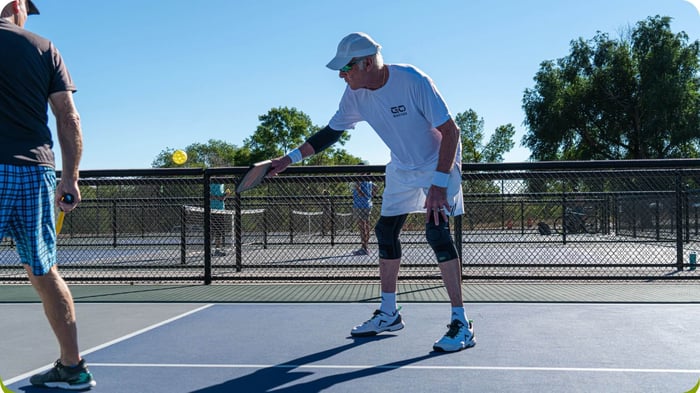
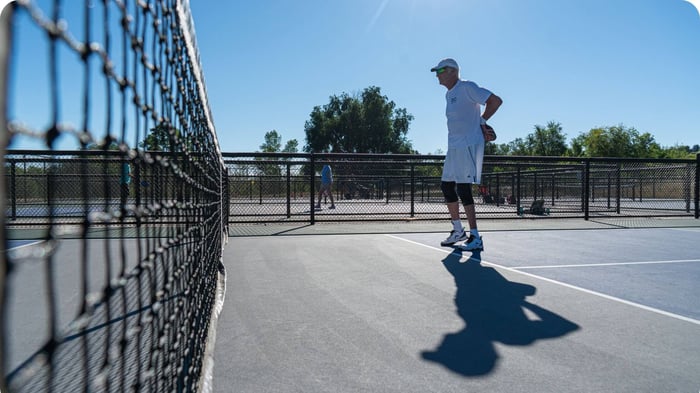 Rick Barry, a Basketball Hall of Famer and top-ranked amateur pickleball player, uses GO Sleeves® to support balance, proprioception, and movement quality for long-term athletic longevity.
What Is Proprioception?
Close your eyes. Touch your nose with your finger. You know exactly where your hand is without looking.
That's proprioception—think of it as your body's internal GPS.
Your nervous system constantly tracks the position and movement of every joint. This feedback comes from three primary sources:
Mechanoreceptors in muscles: Muscle spindles detect changes in muscle length and speed. They tell your brain when a muscle is stretching or contracting.
Mechanoreceptors in tendons: Golgi tendon organs measure tension. They monitor how much force your muscles are generating.
Mechanoreceptors in skin and fascia: Ruffini endings, Pacinian corpuscles, and other sensors detect pressure, stretch, and vibration in your skin and connective tissue.
All of these sensors fire constantly, sending signals to your spinal cord and brain. Your brain integrates this information to create a real-time map of your body's position and movement.
This happens unconsciously. You're not aware of it. But it's running 24/7, coordinating every movement you make.
How Proprioception and Aging Affect Movement and Balance
Your proprioceptive system doesn't fail suddenly. It degrades gradually, starting around age 40.
Receptor Sensitivity Declines
What happens: The mechanoreceptors in your muscles, tendons, skin, and fascia become less sensitive. They require stronger stimulation to fire.
Why: Receptor density decreases. The receptors that remain become less responsive. Changes in tissue composition (collagen becomes stiffer, fascia less mobile) affect how mechanical forces transmit to receptors.
Impact: Your ankle doesn't detect that slight unevenness in the ground as quickly. By the time your brain gets the signal, you've already started to roll your ankle.
Neural Processing Slows
What happens: The speed at which proprioceptive signals travel from receptors to brain decreases. The brain's processing speed also slows.
Why: Nerve conduction velocity decreases with age. Neurons lose some efficiency. The brain has to work harder to integrate sensory input.
Impact: Reaction time increases. If you start to lose balance, your body responds 50-100 milliseconds slower than it did at 30. That delay can mean the difference between catching yourself and falling.
Balance Deteriorates
What happens: Static balance (standing on one leg) and dynamic balance (maintaining stability during movement) both decline.
Measurable decline: Balance decreases approximately 1-2% per year after age 40. By 70, many people have lost 30-40% of their balance capacity compared to their 30-year-old baseline.
Why: Proprioceptive decline combines with vestibular system changes (inner ear balance) and vision changes. The three systems normally work together. When all three degrade, balance suffers significantly.
Impact: Increased fall risk. Reduced athletic performance. Higher injury rates during sports.
Joint Position Sense Degrades
What happens: Your ability to accurately sense joint position without looking decreases.
Research shows: When asked to reproduce a specific joint angle with eyes closed, older adults are 20-30% less accurate than younger adults.
Why: Reduced receptor sensitivity plus slower neural processing.
Impact: During sports, your body makes small position adjustments constantly. Less accurate position sense means those adjustments are imprecise. Imprecise movements lead to compensations, which lead to overuse injuries.
Why This Matters for Athletes Over 50
Understanding the relationship between proprioception and aging is critical for athletes who want to maintain balance, coordination, and injury resilience over time.
Increased Injury Risk
ACL tears: Studies show proprioceptive deficits correlate with non-contact ACL injury risk. Your knee doesn't sense improper alignment fast enough to correct it.
Ankle sprains: Reduced proprioception means your ankle can't react to unstable ground quickly enough. One study found that people with proprioceptive deficits were 7 times more likely to sprain their ankle.
Overuse injuries: When joint position sense degrades, movement patterns become inconsistent. This creates abnormal stress patterns that lead to tendonitis, bursitis, and other overuse issues.
Performance Decline
Coordination: Complex movements require precise timing. When proprioceptive feedback is delayed or inaccurate, coordination suffers.
Reaction time: In sports like pickleball, tennis, or soccer, milliseconds matter. Slower proprioceptive processing means slower reactions to opponents' shots or changing conditions.
Movement efficiency: Your body uses proprioceptive feedback to optimize movement patterns. Degraded feedback means less efficient movement, which means faster fatigue.
Compensation Patterns
When proprioception declines, your body compensates. You might:
Rely more on vision (looking down at your feet more)
Move more cautiously (slower, stiffer movements)
Favor one side (using your "good" leg more)
Avoid challenging movements (no quick cuts or direction changes)
These compensations reduce athletic performance and can create secondary problems.
How to Train Proprioception at Any Age
The nervous system is plastic—it adapts to training throughout life. You can improve proprioception through targeted exercises.
Single-Leg Balance Progressions
Why it works: Forces your ankle, knee, and hip to constantly make micro-adjustments to maintain balance. This trains the proprioceptive system.
Level 1: Eyes Open, Stable Surface
Stand on one leg, 30-60 seconds
Keep standing leg slightly bent
Focus on staying still
3 sets per leg, daily
Level 2: Eyes Closed, Stable Surface
Same as above, but close your eyes
This removes visual input, forcing reliance on proprioception alone
Start with 10-15 seconds, build to 30+
3 sets per leg, daily
Level 3: Eyes Open, Unstable Surface
Balance board, foam pad, or wobble cushion
30-60 seconds per leg
3 sets per leg, 3-4x per week
Level 4: Eyes Closed, Unstable Surface
Advanced - only attempt after mastering Level 3
15-30 seconds per leg
High-level proprioceptive challenge
Level 5: Dynamic Tasks
Balance on one leg while playing catch
Balance while moving through sport-specific positions
React to gentle pushes from partner
Progression rule: Master each level before advancing. If you can hold 60 seconds without wobbling, move to next level.
Barefoot Training
Why it works: Shoes dampen sensory feedback from the ground. Barefoot training enhances input from mechanoreceptors in your feet.
How to implement:
Warm up barefoot on grass or turf (5-10 minutes)
Single-leg balance work barefoot
Agility drills barefoot (slow speed initially)
Gradually increase barefoot training time
Caution: Start conservatively. Feet need time to adapt.
Perturbation Training
Why it works: Trains your body to react to unexpected challenges—exactly what happens during sports.
How to do it:
Stand on one leg on unstable surface
Partner gently pushes you from random directions
Your ankle/knee/hip must react automatically
10-15 perturbations per leg
2-3 sets, 2-3x per week
Progression: Increase push intensity as you improve. Can also do while performing sport movements (throwing, catching).
Sport-Specific Proprioceptive Drills
Soccer/Basketball:
Single-leg hops in multiple directions
Cutting drills at 50% speed on unstable surface
Dribbling while balancing on wobble board
Tennis/Pickleball:
Shadow swings on one leg
Quick direction changes with eyes closed (slow speed)
Reaction drills to partner's calls
Running:
Trail running (uneven surfaces challenge proprioception)
Backward running (removes visual dominance)
Single-leg hopping drills
How Compression Enhances Aging Proprioception
This is where GO Sleeves become particularly valuable for athletes over 50.
The Mechanism
GO Sleeves use embedded silicone patterns that create focal pressure points against your skin. These patterns activate mechanoreceptors in your fascia—the connective tissue layer beneath your skin.
Why this matters for aging athletes:
Your natural mechanoreceptor sensitivity is declining. GO Sleeves amplify the input those receptors receive.
The silicone patterns create directional stretch as you move. This enhanced stimulus makes it easier for aging receptors to fire and send signals to your brain.
Result: Better proprioceptive feedback during movement, even as your natural system degrades.
Research on Compression and Proprioception
Studies show compression garments improve proprioceptive accuracy in healthy adults. In older adults, the effect is even more pronounced because the baseline proprioception is lower.
One study on adults over 60 found that wearing compression during balance tasks improved stability by 15-20% compared to no compression.
The Georgetown College Baseball study with GO Sleeves showed a 98% improvement in balance after two days of training—significantly better than the control group's 16% decline.
Practical Application
During Activity: Many athletes over 50 wear GO Sleeves during training and competition. The enhanced proprioceptive feedback helps maintain better mechanics even when fatigue sets in (fatigue further degrades proprioception).
During Daily Life: Some people wear compression sleeves throughout the day for continuous proprioceptive support. This can help with general mobility and reduce fall risk.
During Proprioceptive Training: Wearing GO Sleeves during balance training may accelerate improvements by providing enhanced sensory feedback.
GO Sleeves use the same biomechanical principles as kinesiology taping—skin stretch to activate mechanoreceptors and enhance proprioception—but built into a reusable sleeve.
No learning curve. Pull it on and go. No figuring out which tape pattern to use or how to apply it correctly.
No daily cost. Tape costs $15-20 per roll and lasts 3-5 days. GO Sleeves last 6-12 months.
No skin irritation. No adhesive residue. No painful removal after sweaty workouts.
Consistent support. Same positioning every time. Tape effectiveness varies based on who applies it and degrades during activity.
Same science. Zero hassle.
The Vision-Proprioception Trade-Off
As proprioception declines, people rely more heavily on vision for balance and coordination.
The problem: Vision-dominant balance is slower and less reliable than proprioception-dominant balance.
Example: Walking on uneven ground in dim light becomes more challenging because you can't see clearly and your proprioception isn't compensating effectively.
The fix: Train proprioception with eyes-closed exercises. This forces your body to rely on proprioceptive feedback instead of vision.
Benefit: When you open your eyes, you have both systems working together—vision plus improved proprioception. This is more effective than vision alone.
Fall Prevention: The Critical Importance
Falls are the leading cause of injury-related death in adults over 65. Most falls result from proprioceptive failure—the body doesn't detect instability fast enough to react.
Statistics:
1 in 4 adults over 65 falls each year
Falls cause 95% of hip fractures
20% of falls cause serious injury
Proprioceptive training reduces fall risk by 20-40% in older adults. This is more effective than strength training alone for fall prevention.
Why: Strength gives you the capacity to catch yourself. Proprioception gives you the reaction speed to actually use that strength.
Both matter, but proprioception is often the limiting factor.
Medication and Proprioception
Some common medications affect proprioceptive function:
Sedatives / sleep aids: Slow neural processing
Blood pressure medications: Some affect balance centers
Anti-anxiety medications: Can impair coordination
Pain medications: Reduce sensory feedback
If you take any of these: Be extra diligent about proprioceptive training. Consider timing medication to avoid peak effects during sports or high-risk activities.
Talk to your doctor about side effects related to balance and coordination.
FAQs About Proprioception and Aging
FAQs
At what age does proprioception start declining?
Measurable decline begins around age 40. The rate is approximately 1-2% per year. By 60, most people have lost 20-30% of their proprioceptive capacity compared to age 30.
Can you reverse proprioceptive decline?
You can't reverse aging of the receptors themselves, but you can train the system to function better. Balance training, proprioceptive exercises, and enhanced sensory input (like compression) improve function even if the underlying hardware is aging.
How long does it take to see improvement from proprioceptive training?
Initial improvements appear in 2-4 weeks. Significant changes take 8-12 weeks of consistent training. The nervous system is plastic but adapts gradually.
Does proprioceptive decline affect coordination in sports?
Absolutely. Proprioception is essential for coordinating complex movements. As it declines, movement patterns become less precise, reaction time slows, and injury risk increases.
Can compression really improve proprioception?
Yes. Research shows compression garments enhance proprioceptive accuracy, especially in older adults. The mechanism is enhanced mechanoreceptor activation through focal skin pressure.
Is proprioceptive training safe for people with knee/ankle problems?
Generally yes, but start conservatively. Use stable surfaces initially. Avoid painful movements. Progress gradually. If you have significant joint instability or recent injury, consult a physical therapist first.
How much proprioceptive training do I need?
10-15 minutes daily is ideal. Even 5 minutes daily of single-leg balance work makes a difference. Consistency matters more than duration.
Do athletes over 50 benefit more from GO Sleeves than younger athletes?
Yes. Younger athletes already have robust proprioception. Older athletes are working with a degraded baseline system. Enhancing proprioceptive input through compression provides more benefit when the natural system is compromised.
Can proprioceptive training prevent falls?
Yes. Studies show 20-40% reduction in fall risk with consistent proprioceptive training in older adults. Combined with strength training, the reduction can be even greater.
How are proprioception and aging connected?
Proprioception declines gradually with age due to reduced sensory receptor sensitivity and slower neural processing, but targeted training and sensory support can slow or partially reverse these effects.
Precision & Grip Control
Proprioceptive Support for the Elbow
Elbow proprioception plays a critical role in racquet sports, throwing mechanics, and grip control. As sensory feedback declines, small positioning errors can cascade into tendon overload and overuse injuries.
GO Sleeves for the elbow enhance mechanoreceptor activation along the forearm and elbow joint, supporting cleaner movement patterns during repetitive or high-precision activities.
GO Kinesiology + Compression Elbow Sleeve

$89.95
Accelerate recovery and reduce pain, swelling, and soreness related to Golf and Tennis Elbow with the world’s only compression sleeves with built-in kinesiology strips to secure, correct, and support key ligaments, tendons, and muscles in and around your elbow. Unlike compression… Read More
Stability & Reaction Time
Proprioceptive Support for the Knee
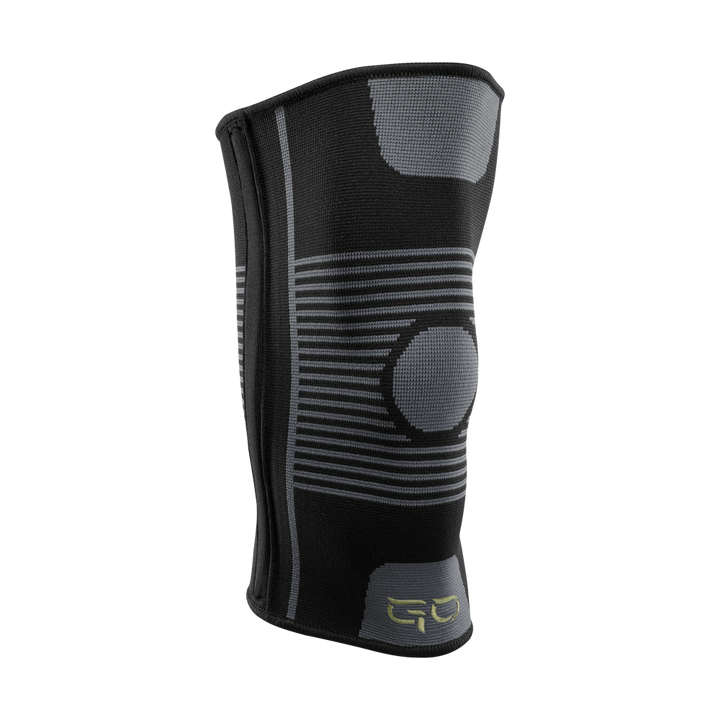
The knee is a proprioceptive hub — integrating input from the hip, ankle, and foot. Age-related decline here is strongly associated with balance loss, slower reaction time, and non-contact injuries. GO Sleeves for the knee provide targeted sensory input around the joint to support alignment, stability, and faster corrective responses during dynamic movement.
GO Kinesiology + Compression Knee Sleeve
$89.95
Don’t let knee pain sabotage your plans! Reduce pain, swelling, and soreness in and around your knee—and accelerate your body’s ability to recover and rebound so you can keep moving. Unlike compression sleeves which just compress, GO Sleeves® Knee Sleeves… Read More
Ground Feedback & Balance
Proprioceptive Support for the Calf
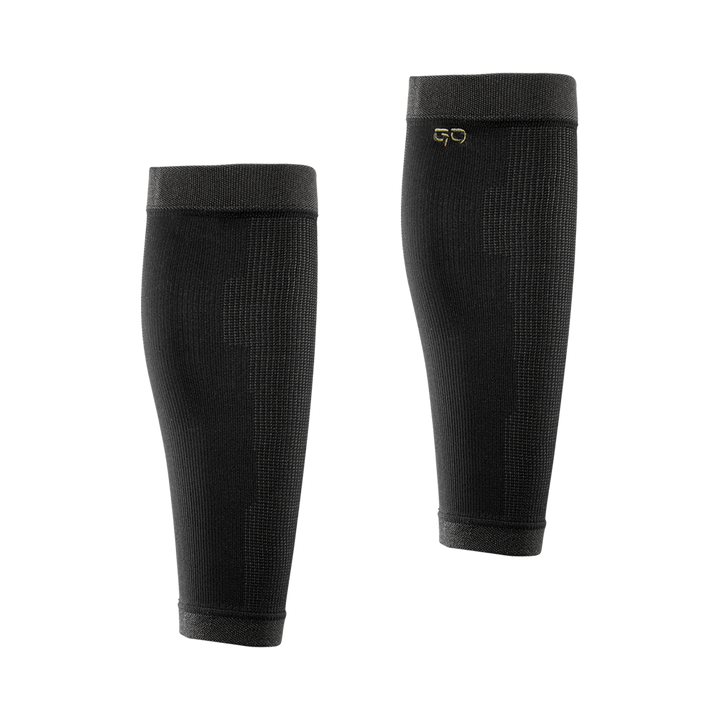
Much of your proprioceptive feedback starts at ground contact. When sensory input from the calf and ankle is delayed, balance corrections arrive too late. GO Sleeves for the calf enhance feedback during foot strike and push-off, helping improve stability on uneven surfaces and during quick direction changes.
GO Kinesiology + Compression Calf Sleeves
$99.95
Just pull them on, and off you go! GO Sleeves® Calf Sleeves are the world’s only compression sleeves with built-in kinesiology strips to secure, correct, and support key ligaments, tendons, and muscles in and around your calf and shin. Unlike… Read More
The Bottom Line
Proprioception—your body's sense of where it is in space—declines about 1-2% per year after age 40. By 60, you've lost 20-30% of your balance capacity.
This is why the science of proprioception and aging matters — it explains both the decline you feel and the levers you can still train.
This affects everything: athletic performance, injury risk, fall risk, coordination, reaction time.
The good news: proprioception is trainable at any age.
Single-leg balance progressions. Eyes-closed training. Barefoot work. Perturbation drills. Sport-specific training. All of these improve proprioceptive function even as the underlying system ages.
Compression that enhances mechanoreceptor activation—like GO Sleeves—amplifies the sensory input your aging receptors receive. This helps maintain better movement quality during activity.
Your proprioception is declining. That's physiology. But with consistent training and proper support, you can maintain athletic performance, reduce injury risk, and stay active for decades.
Train the system. Support the sensors. Keep moving.