Table of Contents
If you've ever been told you have bone on bone knee pain, you've likely heard one of these phrases:
"You have the knees of an 80-year-old."
"It’s bone-on-bone in there."
"You need to stop running to save what’s left."
The mental image is terrifying: your joints are like brake pads on a car, and you have worn them down to the metal. Logic tells you that if you keep driving (moving), you will destroy the axle.
So, you stop. You quit hiking. You quit pickleball. You sit on the couch to "save" your joints.
Here is the tragedy: Resting is the fastest way to destroy your remaining cartilage.
Your joints are not car parts. They are living, biological systems. And unlike brake pads, they require movement to regenerate.
Here is the deep science on why your joints hurt, why "saving them" is killing them, and how to move safely even with arthritis.
The Science of the "Starving" Joint
To understand why movement is medicine, you have to look at the anatomy of Articular Cartilage (the smooth white coating on the ends of your bones).
Understanding why bone on bone knee pain happens starts with your cartilage's biggest weakness: it is Avascular — meaning it has no blood supply of its own. Your muscles get fresh blood delivered constantly by the heart. Your cartilage gets... nothing.
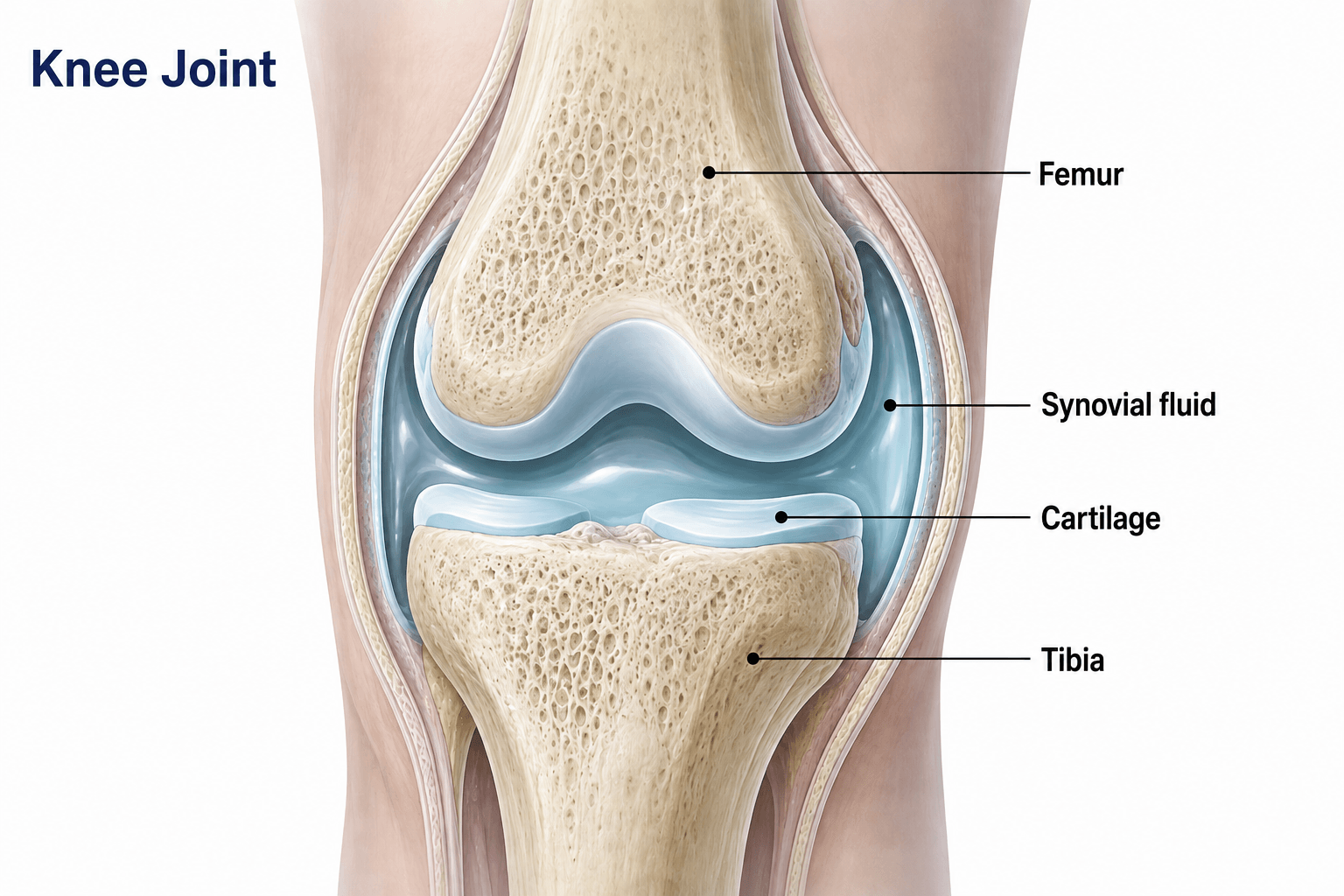 A healthy knee joint relies on synovial fluid to nourish cartilage that has no blood supply of its own.
So, how does it eat? It relies on a process called Imbibition (essentially, the "Sponge Effect"). Your joint is filled with thick, nutrient-rich liquid called Synovial Fluid.
When you step down (Compression): You squeeze waste products out of the cartilage.
When you lift your leg (Decompression): The cartilage expands like a sponge, sucking in the nutrient-rich Synovial Fluid.
This is the crucial rule: If you don't move, you don't pump the sponge. If you sit on the couch to "protect" your knees, your cartilage slowly starves to death. It dries out, becomes brittle, and cracks. Motion is literally lotion. You have to move to feed the joint.
Why It Hurts (And How to Fix It)
If movement is good, why does it hurt so much? Pain in an arthritic joint usually comes from two sources:
Inflammation: The joint is angry and swollen (Synovitis).
Instability: The ligaments are loose, and the joint is "rattling" around, banging into the sore spots. That combination is exactly why bone on bone knee pain feels so unpredictable — better some days, worse on others, without an obvious reason why.
To move safely, we need to stabilize the joint without stopping the movement.
1. Stabilization (The Exoskeleton Effect)
When your natural shock absorbers (cartilage) are thin, your muscles have to work overtime to protect the bone. If your quads or calves are weak or tired, the impact goes straight to the joint. This is where GO Sleeves act as a bridge. The silicone kinesiology strips provide external proprioceptive stability. They cue your muscles to fire instantly on impact, dampening the shock before it rattles the bone. Think of it as tightening the lug nuts on a wheel. The tire might be worn, but if the wheel is tight, you can still drive smoothly.
2. Temperature & Fluid Viscosity
Have you noticed your joints feel worse in the cold? Synovial fluid is like motor oil. When it’s cold, it’s thick and sludge-like. When it’s warm, it’s thin and slippery. GO Sleeves provide thermal compression. By keeping the joint temperature elevated, you decrease the viscosity of the fluid. This makes the "Sponge Effect" more efficient, lubricating the joint faster so you can move with less friction.
The "Joint-Safe" Protocol
You have a diagnosis of Osteoarthritis (the gradual breakdown of cartilage in a joint), and bone on bone knee pain hasn't made you want to quit moving — good, because it shouldn't. Here is your roadmap.
Rule 1: Warm Up Without Impact
Never start a run or game cold. "Grease the groove" first.
Before you stand up: Do 20 knee bends sitting on the edge of the bed. Pump the fluid.
Before you run: Walk for 5 minutes. Get the oil temperature up.
Rule 2: De-Load the Impact
You need the motion (bending/straightening), but you don't necessarily need the slamming.
If running hurts, try rucking (walking with a weighted pack). You get strength and cardio with less impact speed.
Use hiking poles. They offload 20% of the weight from your knees.
Rule 3: Wear Support for Duration
Wear your GO Sleeves during the activity. The goal is to keep the proprioception high so your mechanics don't break down. When you get tired, you start to limp. Limping puts stress on the weird edges of the cartilage that aren't used to it. The sleeves help you maintain a clean, consistent gait pattern.
Rule 4: Respect the Swell
If you finish a workout and your knee is a little stiff, that’s okay. If it is swollen and throbbing, you did too much. Don't quit. Just scale back volume by 20% next time. Find the sweet spot where you can feed the sponge without angering the synovium.
GO Knee Sleeves for Bone on Bone Knee Pain
You can't rebuild lost cartilage, but you can protect what's left — and that's exactly what GO Knee Sleeves are built to do.
The embedded silicone kinesiology strips provide external proprioceptive stability, cueing your muscles to fire the instant your foot hits the ground. That's the "tight lug nuts" effect — the tire might be worn, but a tight wheel still drives smooth. Less shock reaches the joint, and less shock means less of the inflammation and instability that make bone on bone knee pain flare up.
The graduated compression also keeps joint temperature elevated, which thins out synovial fluid the same way warming up motor oil does — making the "sponge effect" more efficient and the joint move with less friction, right from your first step.
Wear them for the duration of your activity, not just the first five minutes. The goal isn't just protection — it's keeping your mechanics clean long enough that you don't start limping and stressing parts of the cartilage that aren't built for it.
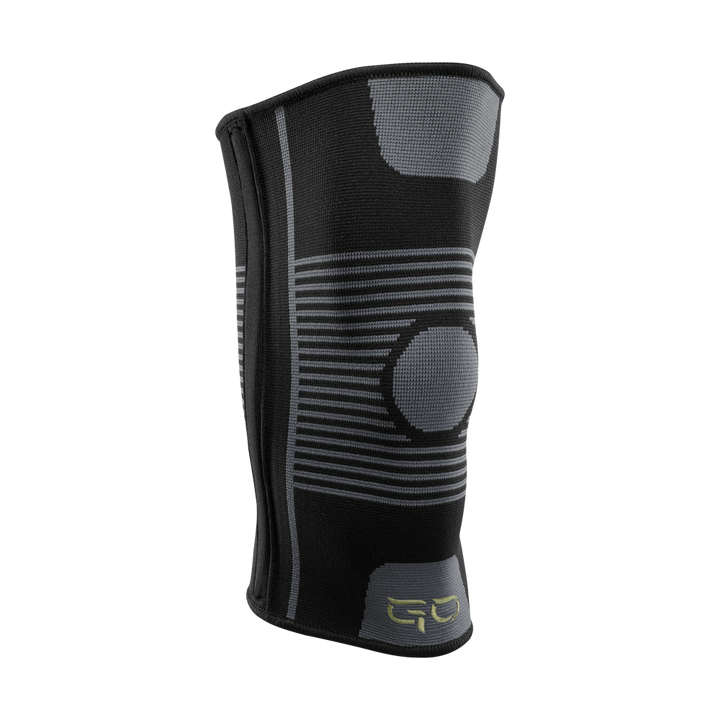
GO Kinesiology + Compression Knee Sleeve
$89.95
Don’t let knee pain sabotage your plans! Reduce pain, swelling, and soreness in and around your knee—and accelerate your body’s ability to recover and rebound so you can keep moving. Unlike compression sleeves which just compress, GO Sleeves® Knee Sleeves… Read More
FAQs
Is running actually bad if I have bone on bone knee pain?
Not automatically. Running itself isn't the enemy — sudden impact without proper warm-up or muscle support is. If running causes swelling that lasts more than a day, scale back volume before cutting it out entirely. Many people with arthritic knees can keep running safely by managing load, not avoiding motion altogether.
Should I ice a swollen arthritic joint?
Occasional icing for acute swelling is fine, but don't rely on it as your main strategy. Bone on bone knee pain responds better to consistent, gentle motion that keeps synovial fluid moving than it does to rest and ice alone.
How do I know if I'm moving too much versus not enough?
A little stiffness after activity is normal and expected. Real swelling or throbbing that lasts into the next day means you did too much — scale back volume by about 20% next session rather than stopping completely.
Can compression sleeves actually help arthritis, or is that just marketing?
Compression itself mostly helps circulation and warmth, which does support joint fluid viscosity. GO Sleeves go a step further with embedded kinesiology strips that add proprioceptive stability, helping your muscles absorb shock so less impact reaches the joint directly.
Do hiking poles actually take pressure off arthritic knees?
Yes — offloading some bodyweight onto poles reduces the impact your knees absorb with each step, which is especially useful on descents where load is highest. It's a simple way to keep hiking without increasing joint stress.
The Bottom Line
"Bone on bone" is a scary phrase, but it is not a death sentence for your active life. Your joints are living things. They are desperate for nutrition, and they only get it when you move. Don't fear the wear. Fear the rust. Strap up, warm up, and keep the pump going. The real story behind bone on bone knee pain is that movement, not rest, is what keeps it manageable.
Medical Disclaimer: The information provided in this article is for educational purposes only and does not constitute medical advice, diagnosis, or treatment. Always seek the advice of your physician or other qualified health provider with any questions you may have regarding a medical condition or injury. Never disregard professional medical advice or delay in seeking it because of something you have read on this website.