Table of Contents
I've watched it happen hundreds of times. Third set. A player goes up for a block, lands hard, and winces. That sharp pain just below the kneecap — the one they've been pretending isn't there for two weeks.
By the fourth set, every jump hurts. The approach gets tentative. They're jumping lower, landing softer, trying to protect the knee instead of playing the game. Performance tanks. And the worst part is, most of them think resting for a week will fix it.
It won't.
That pain is jumper's knee. I've dealt with it myself. I've coached athletes through it at every level from club juniors to Division 1 players. And I can tell you with confidence — if you don't address what's actually causing it, you'll be stuck in a cycle of pain-rest-return-reinjury that can wreck more than just a season. A 2024 prospective study followed elite volleyball players for 11 years and found that jumper's knee is not self-limiting. Athletes who developed it during adolescence reported persistent reductions in knee function over a decade later, with roughly one-fifth retiring from competitive volleyball as a direct result.1
One in five. Gone from the sport because of a condition that's preventable. That’s why learning how to prevent jumper’s knee in volleyball isn’t optional — it’s part of staying competitive long-term.
This guide breaks down exactly why volleyball players get jumper's knee, how to prevent it, and what to do if you're already dealing with pain.
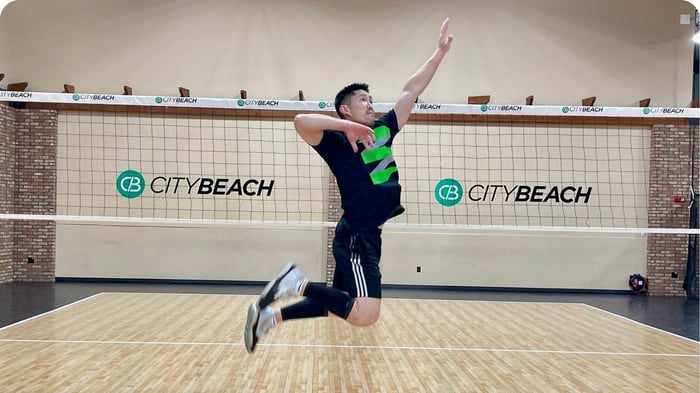
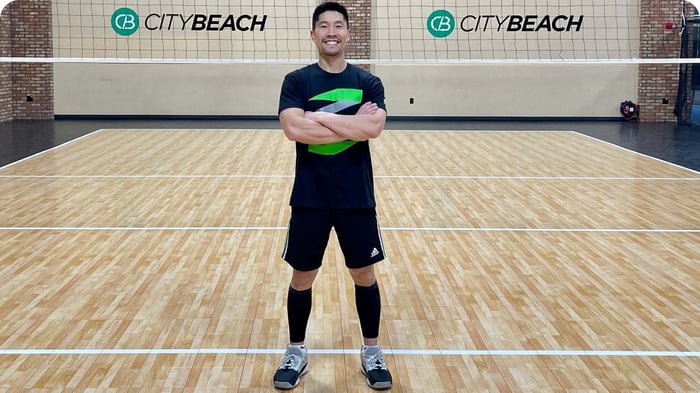 Coach Donny Hui, volleyball coach and athletic performance trainer, author of this guide on preventing jumper’s knee in volleyball.
What Is Jumper's Knee?
Patellar tendinopathy — called jumper's knee in the volleyball world — is degeneration and micro-tearing of the patellar tendon where it attaches to the inferior pole of your kneecap.
It's the most common overuse injury in our sport by a wide margin. A 2023 systematic review and meta-analysis found that volleyball players had the highest prevalence of patellar tendinopathy at 24.8%, compared to 20.8% in basketball and 6.1% in soccer.2 Among elite male volleyball players, cross-sectional studies report prevalence as high as 40–50%.3
I tell my players this all the time: your patellar tendon connects your kneecap to your shinbone. Every time you jump, your quads contract and pull on this tendon to extend the knee. But here's what most people get wrong — the damage doesn't happen during takeoff. It happens when you land.
When you land, your quad muscles decelerate your entire body weight. The tendon is under tension while being lengthened. That's eccentric loading, and the forces involved are substantially higher than what happens during takeoff. That's when the micro-tears occur.
Your body tries to repair those tears between jumps. But we jump hundreds of times per practice. Damage accumulates faster than healing can keep up. The result is chronic pain, progressive tendon degeneration, and — if you ignore it long enough — a condition that follows you for years.
You'll know it when you feel it. Pain just below the kneecap at the tendon insertion. Worsening pain with jumping and landing. Stiffness after sitting for any period of time — I call it the "movie theater test" because players notice it most when they stand up after sitting for an hour. Tenderness when you press directly on the tendon. Pain going up and down stairs. Gradual worsening over weeks or months. Early stages show up as pain after practice. Late stages mean pain during every single jump.
Why Volleyball Is the Worst Sport for Your Patellar Tendon
I've trained athletes across multiple sports. Volleyball combines the worst possible factors for patellar tendon stress, and it's not close.
The volume. A typical volleyball practice involves 200–400 jumps. Games add another 50–100. Tournament weekends can push past 500 jumps over two days. Every single one loads the patellar tendon during the eccentric phase of landing. That's 200–400 loading cycles creating micro-tears before your body has any chance to heal.
The position you play matters. I see it most in my middles — constant blocking at the net means 300+ jumps per practice and the highest injury rate on any roster. Outside hitters generate more horizontal momentum on approach jumps, creating inconsistent stress patterns. Setters jump less but more reactively, which carries its own risk. Liberos carry the lowest risk thanks to minimal jumping.
Fatigue is where the real damage happens. Your first 50 jumps are fine. Quads are fresh, mechanics are clean, tendon stress is manageable. Jumps 200–400 are where things break down. Your quads fatigue. Landing mechanics degrade. More stress transfers directly to the patellar tendon because the muscles that should be absorbing force aren't doing their job anymore. This is the window where movement care matters most — maintaining tissue health and proprioception when your body is tired and your mechanics are slipping.
Muscle imbalances accelerate everything. A weak VMO (inner quad) lets the kneecap pull laterally during landing, creating uneven tendon stress. Tight quads reduce knee flexion range, producing stiffer landings with higher peak forces. Weak glutes allow the knees to cave inward during landing, changing the angle of force through the tendon. Limited ankle dorsiflexion from tight calves forces the knee to absorb even more impact. I screen for all of these in my athletes, and most players have at least two of them.
How to Prevent Jumper’s Knee: Build Tendon Resilience Before It Breaks
Prevention comes down to building tendon capacity and maintaining clean landing mechanics even when fatigue sets in. I treat this as non-negotiable for every volleyball player I work with — it's movement care, the daily proactive work that keeps your body functioning under load. If you want to prevent jumper's knee, you need to build tendon capacity before it breaks down.
Eccentric strengthening is the gold standard. Eccentric exercises load the tendon the same way landing does, building capacity to handle those forces without breaking down. Single-leg decline squats on a 25-degree board are the most evidence-supported exercise for patellar tendon health. A pilot study in the British Journal of Sports Medicine showed that athletes performing eccentric decline squats reduced pain scores from 74.2 to 28.5 on a 100-point VAS over 12 weeks, with six of eight returning to sport.4 A subsequent randomized trial in elite volleyball players confirmed the decline protocol offered superior long-term results compared to standard eccentric exercises at 12 months.5
I have every one of my players do these. The protocol: stand on a decline board, single leg, toes pointing uphill. Lower slowly over 3–5 seconds — that's the eccentric phase, the part that builds tendon capacity. Push back up with both legs. Three sets of 10–12 reps per leg, 3–4 times per week.
Spanish squats complement decline work and I've had great results with them. Loop a band around a fixed point at knee height, step into it so the band sits behind your knees, and lower into a squat. The band pulls your tibia forward, increasing patellar tendon load in a controlled way. Three sets of 10–12 reps, twice per week.
Landing mechanics training. This is where coaching matters. I have my athletes practice controlled landings from progressively greater heights, starting with low box drops at 6–12 inches. Land on both feet, soft knees, weight centered. Progress to single-leg landings. The focus is always quality — quiet landings with no knee valgus. Your body learns what you practice. Train clean mechanics under controlled conditions, and they hold up better when you're gassed in the fourth set.
Hip and glute strengthening. Single-leg hip thrusts, lateral band walks, and Copenhagen planks build the hip stability that controls femoral position during landing. Poor hip control allows the knees to collapse inward, altering the angle of force through the patellar tendon. I've had players eliminate knee pain entirely by fixing their glutes. It's that foundational.
Flexibility work. Quad stretches — 60 seconds per side, daily — maintain the knee flexion range needed for soft landings. Calf stretches and ankle mobility drills ensure your ankles can flex properly during landing so the force doesn't route exclusively through your knee.
Manage your jump volume. I tell my players to track their jumps per practice. When you consistently hit 300–400, modify drills to reduce additional volume. Build volume gradually over months — your tendons adapt slower than your muscles, and that mismatch is where injuries live. Schedule 1–2 complete rest days per week. Tendons need time to repair.
Support patellar tracking under fatigue. This is where GO Sleeves became part of my personal protocol and what I recommend to my athletes. They use embedded kinesiology taping patterns that manipulate fascia and activate the mechanoreceptors responsible for proprioception — your body's sense of where your joints are in space. When fatigue degrades those signals (and it will, by the third set), that continuous fascial stimulation helps maintain the tracking accuracy that protects the patellar tendon during every landing. Unlike kinesiology tape, which degrades during activity and varies based on how well you apply it, the sleeves deliver consistent support every time. Pull them on before warmups and keep them on through recovery.
If You Already Have Jumper's Knee
I'm going to be direct with you. Rest alone won't fix patellar tendinopathy. Without eccentric loading to rebuild tendon capacity, the pain comes back the moment you resume jumping. I've watched too many players take two weeks off, feel better, come back to full practice, and be right back where they started within a week.
Here's the recovery roadmap I use with my athletes.
Phase 1: Reduce inflammation (Week 1–2). Cut jump volume by 50–75%. Eliminate full-speed hitting approaches and maximum-effort blocking. Ice for 15–20 minutes immediately after practice — ice massage directly on the painful tendon works well. Start isometric holds (wall sits at 60 degrees) to maintain quad strength without stressing the tendon. Talk to your doctor about short-term anti-inflammatory options if the pain is significant — though research suggests corticosteroid injections may provide short-term relief but lose their benefit by the six-month mark compared to continued loading-based training.6
Phase 2: Rebuild tendon capacity (Week 3–6). Begin single-leg decline squats at light load in week 3. Increase load gradually if pain stays manageable. Add Spanish squats in week 4–5. Some discomfort during eccentric exercises is normal — up to 4/10 on a pain scale — but pain shouldn't persist more than 24 hours after the session. Continue reduced jump volume. Add box drop landing practice focused on quality, not volume.
Phase 3: Return to full activity (Week 7+). Week 7: 50% of normal jump volume. Week 8: 70% if no pain increase. Week 9: 85%. Week 10: full volume. Continue eccentric work 2x per week indefinitely — this isn't just rehab. It's maintenance. Any return of symptoms means you scale back volume immediately, not push through.
When to see a doctor. Pain persisting beyond 8 weeks despite consistent treatment. Severe pain — 7 or higher out of 10 — even with rest. Swelling behind the kneecap. Knee instability or giving out. Any popping or tearing sensations. You may need imaging to assess tendon damage. Severe cases sometimes require PRP injections or other interventions, and only a physician can determine whether that's appropriate for your situation.
If you're coming back from jumper's knee or dealing with persistent symptoms, work with a sports medicine physician or physical therapist who understands volleyball-specific loading patterns. They can evaluate your mechanics, assess tendon integrity, and build a return-to-play protocol that matches the demands of your position.
How to Prevent Jumper’s Knee in Volleyball: FAQs
FAQs
Can I keep playing with jumper's knee?
If the pain is mild — 2 to 3 out of 10 — and doesn't worsen during practice, you can probably manage it while reducing jump volume and starting eccentric strengthening simultaneously. Moderate to severe pain requires significant rest. I've seen too many players push through severe pain and end up with permanent tendon degeneration. It's not worth it.
How long does jumper's knee take to heal?
Mild cases improve in 4–6 weeks with proper treatment. Moderate cases take 8–12 weeks. Severe chronic cases can require 6+ months. Early intervention dramatically shortens recovery time — every week you wait makes the timeline longer.
Will jumper's knee go away on its own?
No. Rest reduces inflammation temporarily, but without eccentric strengthening to rebuild tendon capacity, pain returns when you resume jumping. I've had players take a full month off, feel great, and be back in pain within a week of practice. Active treatment is essential.
Can I do other sports while recovering?
Low-impact activities are fine — swimming, cycling, upper body lifting. Avoid running, jumping, and cutting sports. Anything that loads the patellar tendon excessively will slow your recovery.
Can compression knee sleeves help prevent jumper’s knee in volleyball?
Standard compression provides some circulatory support but doesn't address the landing mechanics driving the problem. GO Sleeves use built-in kinesiology taping technology that enhances proprioceptive feedback during the eccentric loading phase of landing, helping maintain better patellar tracking when it matters most. They're a meaningful part of my movement care protocol, but they're not a replacement for the eccentric strengthening work.
Should I tape my knee?
Patellar tendon straps placed just below the kneecap can help by changing force distribution. Kinesiology tape may provide some benefit but varies based on application quality and degrades during sweaty activity. GO Sleeves use the same biomechanical principles — fascia manipulation to activate mechanoreceptors — but built into a reusable sleeve with consistent positioning every time. I switched for that reason.
Can weak ankles cause jumper's knee?
Absolutely. Limited ankle dorsiflexion forces your knee to absorb more impact during landing. Calf flexibility and ankle mobility are part of the equation. Stretch your calves daily and add ankle dorsiflexion drills — wall stretches, banded mobilization — to your warm-up.
Will eccentric exercises make my knee hurt more?
Initially, some discomfort during and after eccentric work is normal. Pain should be manageable — 4/10 or less — and shouldn't persist beyond 24 hours. That controlled loading is exactly what rebuilds tendon capacity. If pain exceeds those thresholds, reduce the load and progress more gradually. This isn't a "push through it" situation.
How do I prevent jumper's knee from coming back?
Continue eccentric strengthening 2x per week indefinitely. Monitor jump volume. Address early warning signs immediately — tightness, stiffness, mild discomfort after practice. Maintain hip and glute strength. Use proprioceptive compression support during high-volume periods. Prevention is an ongoing practice, not a box you check once.
The Bottom Line
Jumper's knee develops from repetitive eccentric loading during landing. Volleyball players jump hundreds of times per practice, and the patellar tendon absorbs the force of every one.
Prevention means building tendon resilience through eccentric strengthening, maintaining clean landing mechanics under fatigue, managing jump volume intentionally, and supporting proprioception with tools designed for it.
I've been playing and coaching this sport for over a decade. The players who stay healthy and competitive long-term all share one thing in common — they treat their body's maintenance as seriously as their skill development. Movement care for volleyball means doing the daily work that keeps the system functioning under load. Not waiting until something breaks. Not ignoring the whisper until it becomes a scream.
You don't stop jumping. You give your body a reason to keep landing safely.
If you're dealing with persistent patellar tendon pain or planning a return to full volleyball activity after an extended layoff, consult a sports medicine physician or orthopedic specialist. They can assess tendon integrity through imaging if needed and help you design a return-to-play timeline that matches the demands of your position and training schedule.
References
- Visnes H, Bache-Mathiesen LK, Yamaguchi T, et al. Long-term Prognosis of Patellar Tendinopathy (Jumper's Knee) in Young, Elite Volleyball Players: Tendon Changes 11 Years After Baseline.American Journal of Sports Medicine. 2024;52(13):3314–3323.
- Nutarelli S, Lodi CMTD, Cook JL, Deabate L, Filardo G. Epidemiology of Patellar Tendinopathy in Athletes and the General Population: A Systematic Review and Meta-analysis.Orthopaedic Journal of Sports Medicine. 2023;11(6):23259671231173659.
- Lian ØB, Engebretsen L, Bahr R. Prevalence of Jumper's Knee Among Elite Athletes from Different Sports: A Cross-sectional Study.American Journal of Sports Medicine. 2005;33(4):561–567.
- Purdam CR, Jonsson P, Alfredson H, Lorentzon R, Cook JL, Khan KM. A Pilot Study of the Eccentric Decline Squat in the Management of Painful Chronic Patellar Tendinopathy.British Journal of Sports Medicine. 2004;38(4):395–397.
- Young MA, Cook JL, Purdam CR, Kiss ZS, Alfredson H. Eccentric Decline Squat Protocol Offers Superior Results at 12 Months Compared with Traditional Eccentric Protocol for Patellar Tendinopathy in Volleyball Players.British Journal of Sports Medicine. 2005;39(2):102–105.
- Kongsgaard M, Kovanen V, Aagaard P, et al. Corticosteroid Injections, Eccentric Decline Squat Training and Heavy Slow Resistance Training in Patellar Tendinopathy.Scandinavian Journal of Medicine & Science in Sports. 2009;19(6):790–802.
About the Author
Coach Donny Hui is a volleyball coach, semi-pro player, and athletic performance trainer with over a decade of experience working with athletes from ages 6 to 76. He runs Elevate Yourself, where he shares training content with 600,000+ followers on YouTube. Coach Donny specializes in jump training and movement quality for athletes who want to compete at high levels while staying healthy long-term. Learn more at ElevateYourself.org. Coach Donny is a GO Sleeves ambassador.
Medical Disclaimer:
The information provided in this article is for educational purposes only and does not constitute medical advice, diagnosis, or treatment. Always seek the advice of your physician or other qualified health provider with any questions you may have regarding a medical condition or injury. Never disregard professional medical advice or delay in seeking it because of something you have read on this website.
Movement Care for Volleyball Athletes
Preventing jumper’s knee in volleyball isn’t about one exercise or one recovery tool. It’s about maintaining tendon capacity and clean landing mechanics across thousands of jumps.
In volleyball, the highest stress point during play is predictable: the patellar tendon.
During takeoff and especially landing, the quadriceps contract eccentrically to decelerate body weight. As fatigue sets in:
Quad activation declines
Landing mechanics become stiffer
Knee valgus increases
Patellar tendon load rises
Recovery between practices becomes critical
Movement care in volleyball means maintaining tissue quality, proprioception, and joint stability over the course of a long season — not just getting through one match.
GO Knee Sleeve — For Patellar Tracking + Proprioceptive Support
Unlike rigid braces that restrict motion, the GO Knee Sleeve is anatomically mapped to follow the patellar tendon and quadriceps line of pull.
It is designed to:
Enhance proprioceptive feedback during jumping and landing
Support patellar tracking under fatigue
Maintain tissue warmth between sets
Promote circulation during recovery
For volleyball athletes logging 200–400 jumps per practice — especially during tournament weekends — maintaining neuromuscular control late into matches matters.
The sleeve doesn’t replace eccentric strengthening or landing training. It complements them.
Best for:
Middles with high blocking volume
Outside hitters generating heavy approach momentum
Athletes returning from patellar tendinopathy
Tournament play with multiple matches in a day
In-season load management
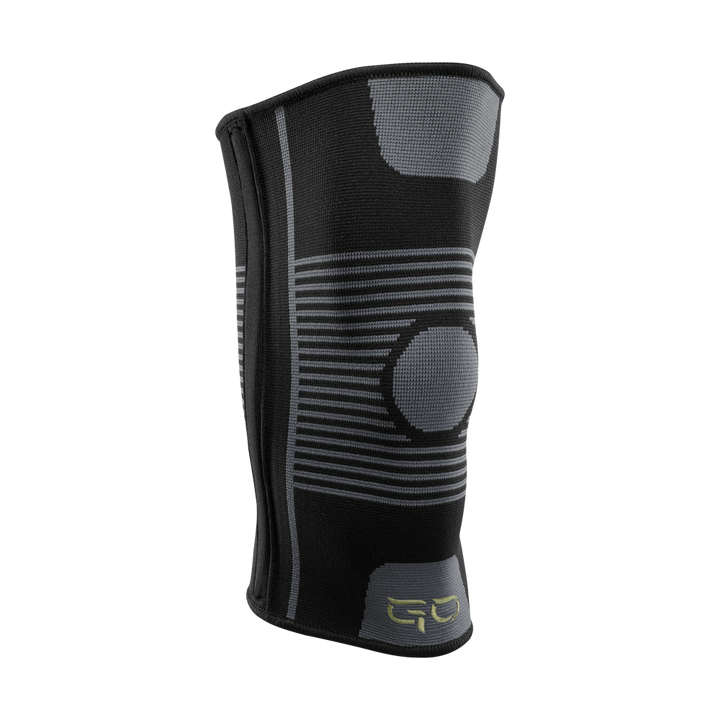
GO Kinesiology + Compression Knee Sleeve
$89.95
Don’t let knee pain sabotage your plans! Reduce pain, swelling, and soreness in and around your knee—and accelerate your body’s ability to recover and rebound so you can keep moving. Unlike compression sleeves which just compress, GO Sleeves® Knee Sleeves… Read More
Preventing Jumper’s Knee Isn’t About Bracing — It’s About Preserving Function
Volleyball players don’t develop patellar tendinopathy from one jump. They develop it from accumulated eccentric load over time.
Movement care supports:
Strength
Mechanics
Recovery
Joint awareness
Tendon resilience
When those layers work together, the knee is better protected across a long season.
Explore the full system of movement care tools designed for volleyball athletes who want longevity — not just vertical.